

You already know you need some form of testing. The question that keeps coming up is which one actually fits your environment. Is a traditional pen test enough, or is it time to consider something more like a red team exercise? If you are asking yourself that, you are not alone.
Many IT and security leaders find themselves in a difficult middle ground. Budgets are tight, teams are stretched, and there is constant pressure to show due diligence without slowing delivery. In that context, choosing the wrong type of security assessment can quickly lead to overspend, under-scoped work, or a test that arrives before your teams are ready to support it.
To avoid that, it helps to be clear on what penetration testing actually delivers, what red teaming is designed to achieve, and how to decide which one makes sense for your organisation right now.
What Pen Testing Services Actually Provides:
Pen testing gives you a clear view of where your systems are vulnerable right now. It is a focused, scoped assessment that tells you which weaknesses could be exploited and how to fix them.
You define the boundaries at the start. Specific assets, applications, or networks are agreed so the exercise stays predictable and manageable. This is especially helpful when internal time and resources are limited.
A typical pen test covers areas like:
- External or internal infrastructure
- Cloud hosted services
The output is practical. Your IT and security teams receive a report that includes:
- Confirmed vulnerabilities
- The real world impact
- Clear remediation steps
- Risk based prioritisation
Because the findings map neatly into ticketing systems and BAU workflows, the work that follows is straightforward. Teams can assign, track, and resolve issues without disrupting operations.
Pen testing services is usually the right choice when you need targeted assurance. It helps you validate systems, support compliance requirements, and identify issues before they affect the business. It is direct, predictable, and designed to support day to day security improvement.
Red Team in Cyber Security: Testing More Than Just Technology
Red teaming helps you understand how your organisation would cope with a realistic attack, not just whether a vulnerability exists. It focuses on how well your teams can detect, contain, and respond when something suspicious happens.
Instead of testing a single system, the exercise looks at the bigger picture. It uses real world attacker behaviour to see how far an attacker could get and how quickly your monitoring and response functions react. This means your SOC, IT operations, and incident response teams all play a role.
Because of this, red teaming needs more preparation and alignment than a standard pen test. You need clear objectives, agreement from stakeholders, and enough internal capacity to support an interactive exercise. It also takes longer, since testers explore multiple routes and techniques rather than sticking to a predefined scope.
The value is in the insight you gain. A red team engagement highlights:
- Gaps in visibility
- Missed alerts or delayed responses
- Process breakdowns
- Situations where responsibilities or handoffs are unclear
It is less about finding individual vulnerabilities and more about understanding how your organisation functions under pressure.
For leaders, red teaming provides a realistic measure of resilience and a clear view of where improvements will have the greatest impact. It is not designed to intimidate teams, but to help you strengthen the whole detection and response lifecycle.
Choosing Between Pen Testing Partners and Red Team Testing at a Glance
Before diving deeper, it helps to see the practical differences side by side.
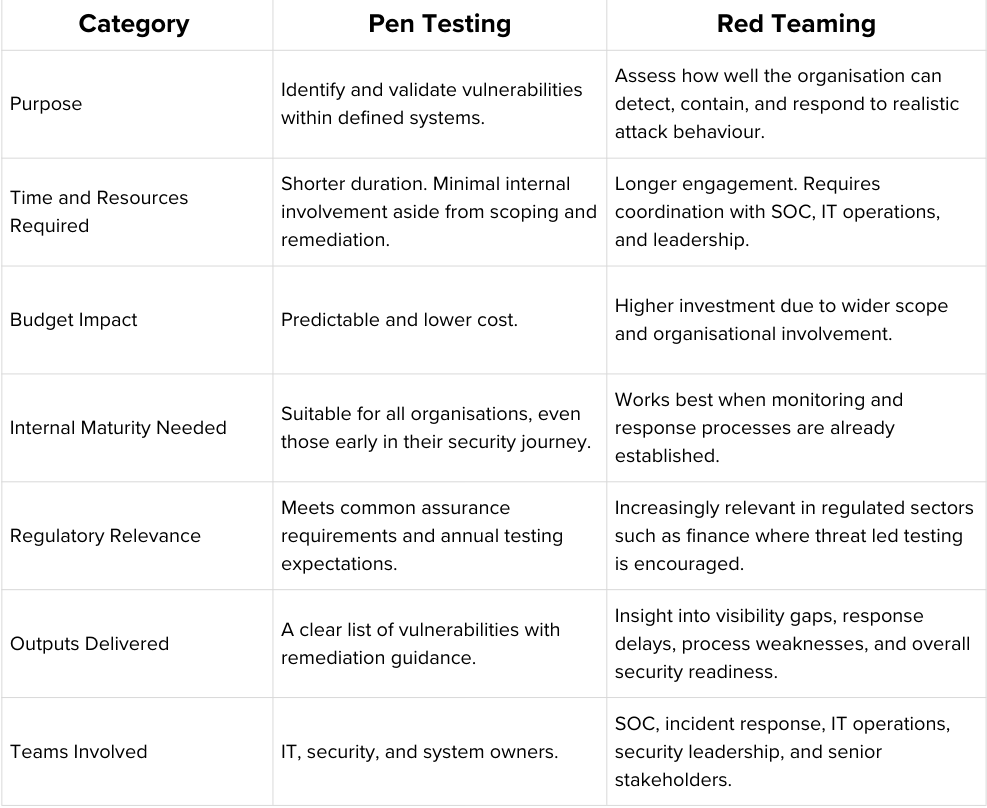
Real World Factors That Should Drive the Decision
Choosing between pen testing and red teaming is not about which method is more advanced. It is about what fits your organisation’s reality. These factors will help guide a defensible decision.
a) Data Sensitivity and Business Impact
If the systems you are testing hold critical data or support essential services, you may need more comprehensive testing. Higher impact environments often benefit from exercises that look beyond vulnerabilities and explore how well the organisation can detect and react.
b) Security Maturity
Pen testing works for every maturity level. It gives you clear technical findings you can act on immediately.
Red teaming is different. It requires monitoring, alerting, and response processes to be in place. Without these foundations, the exercise will not give you meaningful results.
c) Company Size and Complexity
Smaller or less complex environments may not gain much from full red teaming yet, especially if visibility and processes are still developing.
Larger or distributed organisations often need higher realism to understand how security functions across systems, teams, and locations.
d) Budget and Time Capacity
Pen testing is predictable and easier to support. It fits well when you have limited internal bandwidth.
Red teaming takes more coordination. It involves more stakeholders and a heavier follow up effort. The value is significant, but only when you have the capacity to engage with it properly.
e) Regulation and Industry Expectations
Some sectors, such as finance or critical services, are increasingly guided toward threat led exercises or specific frameworks that resemble red teaming.
Others simply require regular assurance through pen testing. Understanding your regulatory landscape helps prevent unnecessary spend and ensures compliance is met without over committing.
How to Decide What Type of Pen Testing Companies Fit Your Environment
The decision becomes much easier when you step back and look at what you actually need from the exercise. Start with intent. Understanding what you want to achieve will often narrow the choice straight away. Then layer in the practical realities around time, people, and expectations from leadership.
Ask yourself:
- What is my primary objective right now? Am I trying to find and fix vulnerabilities, or test how well we detect and respond to real activity?
- Do we have a functioning SOC or monitoring capability that could actively engage with a red team exercise?
- Do we have the time and internal capacity to support an interactive engagement, including follow up and improvement work?
- What would our board or senior leadership expect to see as evidence from this test?
- Does regulation or industry guidance influence the type of testing we should be doing at this stage?
Answering these questions helps you make a confident, defensible decision. It also ensures the exercise you choose delivers practical value without creating unnecessary strain on your teams.
Pen Testing In The UK: There is no single “best” option when it comes to security testing.
What matters is what fits your organisation’s risk profile, maturity, and day-to-day reality. Pen testing and red teaming serve different purposes, and both can be the right choice at different points in time.
The problems usually start when decisions are made reactively. A test is commissioned because of pressure from above, an audit finding, or something that has just happened elsewhere. That is when organisations overspend, run exercises they are not ready to support, or walk away with results they cannot fully use.
When the choice is made thoughtfully, testing becomes far more valuable. You know what you are trying to prove. You understand what success looks like. And you can clearly explain to leadership why this approach makes sense now, and what it will and will not tell you.
If you are still weighing up which path to take, support can make that decision easier. Equilibrium Security and OmniCyber can help you assess your current position, choose the right approach for your organisation, and carry out the testing in a way that delivers practical, defensible outcomes.
The goal is not to follow trends. It is to choose the option that genuinely strengthens your security posture and works for your teams today.